

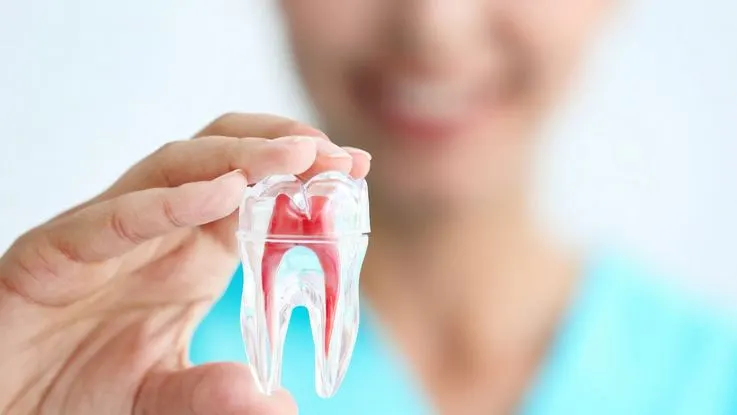
Root canal treatment: some people suffer serious dental problems, including damage to the tooth roots. The roots are the part of the tooth submerged in the gum and connected to the upper and lower jawbones. Their function is to protect the teeth from external factors such as cold and hot food and air. Exposed and worn roots are among the problems that can lead to teeth being affected and falling out, along with severe pain when eating or drinking hot and cold things, and when the teeth are exposed to open air.
The aim of treating damaged roots is to deal with a tooth whose layers have gradually worn away because of severe decay, in cases where the decay breaks through the outer layers of the tooth and reaches the pulp, which contains blood vessels and nerves. Root canal treatment is for teeth where the infection has reached the nerve. It is an alternative to extraction: the teeth can be kept for life by cleaning the roots and the tooth canals of the living tissue inside them, then filling the space left behind, which closes the root canal.
How many roots do teeth have?

The number of tooth roots and root canals varies according to the position of each tooth, as shown below:
- The upper first premolars have two roots and two root canals.
- The lower first and second molars have two roots and three root canals.
- Each of the upper front teeth, known as the incisors and canines, has one root and one root canal.
- The lower second premolars have one root and one root canal.
- Each of the lower front teeth (the canines and incisors) also has one root and one root canal.
- The upper first and second molars have 3 roots and 4 root canals.
- The upper second premolars have one root and two root canals.
- The lower first premolars have one root and one root canal.
What factors affect tooth root exposure?
- Gum pockets resulting from chronic infections.
- Violent brushing of the teeth.
- Tartar deposits, decay and a build-up of plaque.
- Advancing age is one of the causes of wear and exposure of the tooth roots.
- Chronic gum infections.
- Deep decay in a tooth.
- A crack in the tooth.
- Damage to the tooth from a hard blow to it in the past or recently.
When is root canal treatment needed?
The main symptoms the patient faces include:
- A hole in the body of the tooth.
- Swelling in the neck or face.
- A swelling in the supporting tissue of the tooth.
- Sensitivity from drinking cold or hot drinks.
How are the tooth roots and canals treated?

- First the dentist gives you an anesthetic so that you feel no pain and are more comfortable during treatment, then opens an access hole in the crown of the tooth to reach the root canal that contains the nerve.
- After the pulp is removed (the “pulpectomy” procedure), the pulp cavity and the base of the roots are cleaned and widened so the canal can be filled.
- Then the pulp space and the canal are filled permanently. A rubbery material with a pointed tip called gutta-percha is inserted into each canal and is usually bonded in place, and sometimes a metal or plastic post can be inserted into the canal to give it structural support.
The most common way to confirm whether the procedure has succeeded is to compare the X-rays taken before treatment with the new X-rays taken after it. The comparison shows whether bone loss is continuing or whether the bone is being rebuilt.
Also read: Orthodontic headgear
So, dear reader, I hope I have made clear what root canal treatment is, the main factors affecting it and how the treatment of tooth roots and canals is carried out.
This article is for general education and is not a diagnosis or a substitute for advice from your dentist.