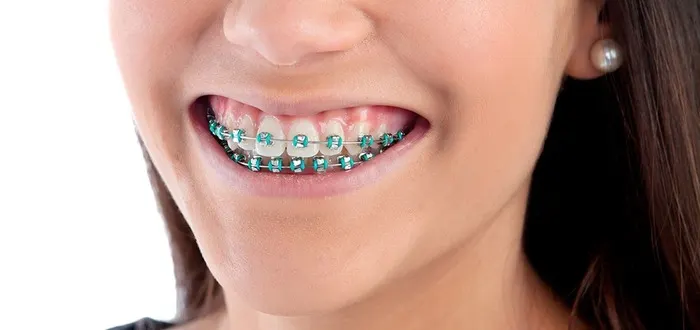
What are the types of braces, with pictures and prices? There are many types of orthodontic treatment, and the best treatment depends on the exact problem the person has. The first step in any treatment is assessing the current condition of the teeth and the likelihood of their changing over time, which often involves taking X-rays and photographs of the teeth. So follow along with this article for more details.
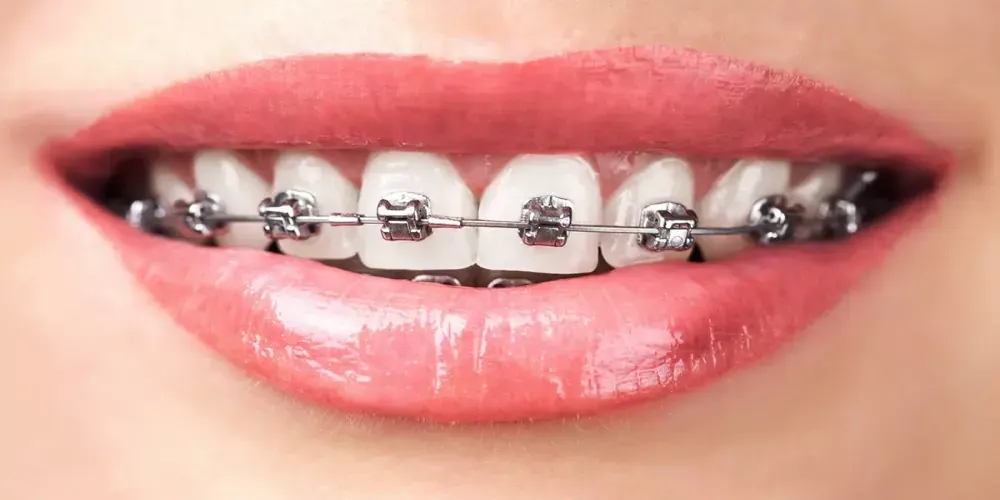
Metal braces
In the search for types of braces, traditional metal braces are the best-known type of fixed braces. They consist of high-quality stainless steel brackets attached to each tooth using a specific type of adhesive that does not harm the teeth. Here is more in the following points:
- These brackets are connected to each other with the help of a metal wire and pieces of rubber, and the dentist tightens them in a particular way to apply pressure to the teeth and straighten their position.
- Metal brackets are the most common and the cheapest. They suit children and adults and deal effectively with difficult cases.
- But they have some drawbacks, such as their unattractive look. Some people suffer from food sticking to the teeth and difficulty cleaning the teeth while wearing them. The period of wearing metal braces is a year and a half to four years.
- Their price is from 4,000 to 7,000 Saudi riyals.
Ceramic braces
Continuing the discussion of types of braces, ceramic braces are a type of invisible fixed braces. Their brackets are very similar to metal brackets in size and shape, but they are made of porcelain or clear ceramic so they blend with the natural color of the teeth, and they are connected to each other with a plastic wire. Follow the points below:
- This type of brackets moves the teeth faster than clear aligners and is as effective as traditional braces in getting the teeth to move into the desired positions.
- But they may be a little slower than metal brackets, because they break easily and it takes some time to repair them.
- Ceramic brackets are invisible because of their color, which makes them the favored choice of many people.
- Some patients find ceramic clips delicate and prone to damage because of their smoothness and fragility, but in fact ceramic brackets are durable and stay stable throughout the treatment period.
- Ceramic braces do not produce the many signals that interfere with X-ray and ultrasound devices the way metal appliances do.
Disadvantages of ceramic braces
In presenting the types of braces, despite the many advantages of ceramic braces, they have some drawbacks that can be set out in the following points:
- Some patients shy away from ceramic ties because ceramic brackets are bigger than metal ones. On the other hand, it should be remembered that ceramic brackets match the tooth color, which reduces the effect of their extra size.
- Staining of the teeth, because the braces are connected to each other by small pieces of rubber.
- Since rubber is a permeable material, the longer it stays on the teeth, the more stains show up on the teeth, which the dentist will remove after the treatment period and after the brackets are removed.
- However, this drawback is common to both ceramic and metal braces, so it does not affect the patient’s choice of one type or the other.
- Limited pressure tolerance: although ceramic brackets are strong and durable, this durability is effective only up to a certain pressure point.
- If the ceramic brackets are put under too much pressure for a long time, they may be damaged and break.
- So if the teeth’s condition requires intensive treatment, the dentist may advise choosing metal brackets rather than ceramic.
- High cost, as ceramic braces are among the most expensive types of braces.
Lingual braces
In the context of types of braces, this type is used in the same way as metal braces, but the difference is that in this case the metal brackets and rubber wires are fitted on the inside of the teeth. The brackets are fitted from the inside of the teeth and are small. This type does not stick to the cheek side of the teeth. If you do not want the appearance of your teeth spoiled and do not want anyone to notice the braces, fit this type of braces. You can clean your teeth. The teeth are held well with this type of brackets, and flossing can be done without any interruption.
Advantages of lingual braces
In the context of types of braces, braces are a cosmetic procedure some people use to straighten crooked teeth, and lingual braces have many different advantages that can be set out through the following points:
- Internal (lingual) fixing of the braces is the best solution for people who do not want anyone to notice their braces, which means this advantage is the most important and best feature in these cases.
- This type of braces helps solve the complex dental problems that can face the teeth, such as rotated and tilted teeth.
- Whereas hidden removable braces can only solve the simple problems facing the teeth.
- Since this type of braces does not show on the front side of the teeth and does not affect the outer look of the teeth, it leaves a good, comfortable psychological effect on the people who use it.
- When hidden internal appliances are fitted, you can clean your teeth comfortably and well with a brush and paste, as well as flossing well. Even if staining or discoloration forms, it will not be visible because it can form on the inner surface of the teeth.
Disadvantages of lingual braces
As we discussed types of braces, despite the many advantages lingual braces have, they have many drawbacks you should know before turning to fitting them. The most important are:
- Fitting lingual brackets is considered a difficult method for the dentist and is more complicated than fitting other types of braces such as metal and ceramic brackets.
- Since lingual braces sit on the inner side of the teeth and require fitting a lingual bracket, they affect pronunciation and speech, especially at the start of treatment, which causes some discomfort. But over time the person gets used to the brackets and their pronunciation becomes better and easier.
- Lingual braces can be considered among the most expensive types of braces compared with the other types.
- Treating the teeth with lingual braces takes longer compared with other types of braces.
Clear braces
In presenting the types of braces, this is a jaw appliance made from a material that is easy to clean, which is plastic or another clear material called acrylic. It is used in simple cases such as mildly crooked teeth or any problem that does not require strong treatment to tighten the teeth, such as a strong protrusion in the upper or lower jaw.
Appearance of clear braces
As we talked about types of braces, the shape of the clear dental appliance is made from a clear material resembling the natural structure of the affected jaw, whether upper or lower, and is fitted according to the tooth size taken from each patient by the specialist dentist, who sends it to the orthodontic manufacturing centers.
These braces do not contain chains or metal parts like those we noticed and used in traditional metal braces, so they can be removed easily whenever the person wants, whether to eat or for other reasons.
Price: 8,000 to 16,000 Saudi riyals.
Disadvantages of clear braces
In light of the discussion of types of braces, despite all the advantages, clear braces, like any medical invention, are not complete without certain drawbacks, including:
- The high cost of fitting clear braces.
- They do not align or press the teeth to the same degree as metal brackets.
- Some people may be exposed to infection after the appliance is removed and refitted repeatedly.
- They are not suitable for all dental problems.
Surgical orthodontics
Continuing the discussion of types of braces, surgical orthodontics is a joint and coordinated treatment between orthodontics and jaw surgery. This treatment method is wanted for difficult orthodontic cases marked by a clear difference in growth or a clear poor relationship between the upper and lower jawbones, such as protrusion in the upper or lower jaw, or one of them dropping back. Follow the points below:
- This type of case requires a joint treatment plan and coordination of treatment between the orthodontist and the oral surgeon.
- In general, surgery happens 12 to 18 months after traditional orthodontic treatment, especially as early intervention can avoid the need for surgery or reduce its severity and extent.
- Surgical orthodontics is a treatment for bite misalignment and deformities affecting the jaws and teeth that are difficult to correct with traditional braces.
- The surgery involves the orthodontist and the maxillofacial surgeon, with whom a coordinated treatment plan is drawn up to correct the jaw mismatch.
- When the patient visits the orthodontist, the X-rays and photographs needed for diagnosis are taken.
- Measurements of the jaws are taken to help the orthodontist make the right diagnosis of the case and decide on the treatment plan.
Removable braces
Alongside the types of braces, this is a set of metal wires with a light plastic base, generally used after the original orthodontic treatment is completed.
This type of braces has many advantages compared with other types of braces, including:
- This type of braces is inexpensive.
- It is easy to use, and also easy to clean.
- It can be removed and refitted easily without needing a dentist.
- It is fitted behind the teeth, not in front of them.
Types of removable braces
It has two types of braces, which can be identified as follows:
- Removable metal braces: the first type is a set of stainless steel wires with a lightweight plastic base.
- They need to be tightened every 4 to 6 weeks for longer and better effectiveness.
- Removable clear braces: the second type is a clear plastic mold with no wires or lobes attached to the teeth, and clear aligners are invisible and do not show when you smile.
- Price: 3,000 to 7,000 Saudi riyals.
Laser braces in Saudi Arabia
In the context of types of braces, laser is one of the modern technologies that has spread across many areas of life such as medicine. It is done using a device that emits light (electromagnetic radiation) onto part of the tooth to treat or correct it, as a tool for cutting tissue and dissolving tissue. Laser braces have become one of the best ways to straighten teeth so they look better, as laser is used to treat the jaws and correct many aspects of implants, cavities and whitening. In addition, laser can correct crooked teeth, which may be hereditary, to relieve the owner’s frustration with the look of their smile.
Advantages of laser braces
Laser reduces the gum bleeding that can happen during surgery and reduces pain and swelling during and after laser use, and has other advantages that we set out as follows:
- Laser is characterized by ease and precision of use, reduces the use of rough materials such as porcelain, and shortens the recovery period needed after laser.
- Orthodontic surgery does not make annoying noises like other traditional tools, and laser treatment does not tire the patient like other tools.
Braces prices in the Kingdom of Saudi Arabia
The price of metal and ceramic braces in Riyadh is between 5,000 and 12,000 Saudi riyals, while the price of removable brackets may be close to this amount or differ slightly.
Some clinics also offer other types and techniques of braces that aim only at getting the look of braces on the teeth for decorative purposes without achieving any treatment goal. The price of decorative brackets in Riyadh is also noticeably lower than the other types, ranging from 70 to 160 Saudi riyals.
Fixed brackets
Continuing the discussion of types of braces, brackets cause small gaps between the teeth where food particles can collect and cause increased build-up of plaque full of bacteria. Failing to remove food deposits and plaque also leads to:
- Loss of minerals on the outer enamel surface of the teeth, leading to permanent white spots on the teeth
- Tooth decay and gum disease.
- After the braces are removed it is necessary to hold the newly straightened teeth in place for a period of time (the retention period) to stop them from returning to their original position.
- This is done using a specially designed plastic retainer, or plastic and metal wires that hold the teeth in place (retention).
- To be stable, a set of fixed retention tools may also be used in addition to removable retainers.
Removable brackets
Instead of using fixed wristbands, which are more useful for some people who only need slight corrections, from a series of custom removable appliances called clear aligners, people often wear each set of aligners for between one and three weeks, for about 24 hours a day as far as possible, but remove them for eating or brushing or flossing and replace them with the second set. The whole series of aligners can last up to nine months or more, allowing better alignment.
Only plain water can be drunk while wearing the aligners. After removing the aligners to eat or drink anything else, make sure to brush your teeth before putting the aligners back, and floss as directed at least once a day.
Functional orthodontic appliances
Functional orthodontic appliances are removable appliances used to improve the lower jaw and treat class 2 deformities. Using these appliances, several operations take place, which we go through as follows:
- The function or performance of the upper or lower jaw is changed, including class 2 deformities.
- These appliances are divided into sub-categories, and there are two types: fixed and removable. The fixed type is fixed to the tooth and cannot be removed by the patient.
- One of the most important advantages of the fixed appliance is that it reduces the patient’s need to keep putting the appliance in, but looking after it is harder and requires more precision.
- The removable appliance, on the other hand, can be removed by the patient and put back in the mouth at any time, and caring for removable appliances is easy compared with fixed ones, but these appliances need more cooperation from the patient to give a proper treatment response.
- Functional or applied orthodontic appliances are among the different types of orthodontic appliances used to treat jaw deformities in people who suffer from them.
Orthodontic headgear
As we talked about types of braces, this is a type of orthodontic appliance normally connected to the patient’s head with straps or bands around the head or neck. From this point of view, the force is transferred to the mouth and jaw (or jaws).
Headgear is a support used to correct the bite and support a healthy pattern of jaw growth. In general, using headgear is recommended for children whose jaws are still growing.
In conclusion, we have covered the types of braces with pictures and various prices, and we mentioned the drawbacks and advantages of each type. Happy reading to everyone.
Also read: The clinic’s doctors
This article is for general education and is not a diagnosis or a substitute for advice from your dentist.